
Constructor Theory, Module 1: The Prevailing Conception and the Big Bang
Constructor Theory, Module 1: The Prevailing Conception and the Big Bang, by Conjecture Institute President Logan Chipkin.

The following is the written version of Constructor Theory, Module 1: The Prevailing Conception and the Big Bang, by Conjecture Institute President Logan Chipkin (AI audio version on our site and embedded below). Head to Conjecture Institute’s Courses page for more. We will be adding modules across a number of courses throughout the year.

How Physics Normally Explains Things
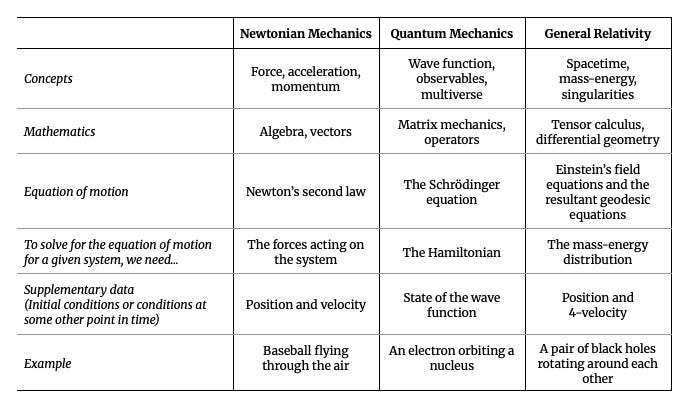
While Newtonian mechanics, quantum mechanics, and general relativity consist of radically different conceptual frameworks and mathematical infrastructure, they are all expressible in what David Deutsch and Chiara Marletto call the prevailing or traditional conception.
If you know the current positions and velocities of the planets, Newton’s laws let you calculate where they will be next year, or where they were last year.
If you know the wave function of an electron and the rule governing how it changes, quantum mechanics lets you compute its entire future and its entire past.
If you know the positions and velocities of two black holes at the current moment, Einstein’s equations in general relativity fix their entire evolution in spacetime — forward or backward.
This way of explaining the world is so familiar that we rarely notice it.
For a given theory in physics, we have:
A law of motion that tells us how the state of a system changes.
The state of the system at some moment.
From those two ingredients, the system’s entire past and future are fixed.
Such laws are deterministic: once the state at one time is given, everything else follows.
They are also time-reversal symmetric: if a sequence of states is allowed in one direction, the reverse sequence is allowed as well. If the equations permit A → B, they also permit B → A.
But there are open problems in physics for which the prevailing conception is inadequate.
For instance: discovering the initial state of the universe would be one of the greatest empirical discoveries in the history of science. And yet we’d still be left wondering: why this initial state rather than any other?
To explain and deduce our universe’s actual initial state, a deeper theory, expressed in an entirely new and deeper conceptual language, is needed.
Reader’s note: this first section is a high-level overview of the prevailing conception and its shortcomings with respect to explaining the state of the universe at the Big Bang. Subsequent sections offer a more granular exploration, but you may consider these as supplementary material.
The Prevailing Conception
Whether or not a baseball player has hit a home run isn’t known to the crowd until the baseball is well on its trajectory through the air, but, thanks to Newton, we know that whether or not the baseball will escape the stadium is determined by just a handful of parameters and so-called equations of motion. If we know the baseball’s position and velocity just after the athlete hits it, and if we know the forces acting on the baseball during its time in the sky, then we can predict its entire trajectory until it reaches the ground.
If we ignore air resistance and the motion of the Earth, then the only force acting on the baseball during its trajectory is the Earth’s gravity, which pulls the object downwards with an approximately constant strength. Newton’s second law of motion tells us how all of the forces acting on an object collectively change the object’s velocity over time (change in velocity over change in time is called acceleration). In this case, we are only dealing with a single force that does not itself change across time or space, making the calculations relatively simple. A constant force causes a constant acceleration, and so we know how the baseball’s velocity will change over time—it will decrease from its initial value at a constant rate until it reaches the ground. And since velocity is just an object’s change in position over change in time, we can calculate the baseball’s position at every instant as well—provided we know its initial value.
If we did take air resistance into account, Newton’s second law of motion would be more complicated, since we would have to track not only the approximately constant force of Earth’s gravity but also the force of air resistance, which itself depends on the velocity of the baseball. So deducing the baseball’s position and velocity is made more challenging, but the recipe is the same. We start with Newton’s second law of motion and the forces acting on the object in question (i.e. the baseball). From those, we deduce the object’s position and velocity as functions of time. Then we plug the initial conditions of the object into those functions and calculate its position and velocity at any arbitrary instant of time. In this way, Newton’s laws are deterministic—if these functions are correct, then the baseball cannot deviate from the trajectories that the functions imply.
As with baseballs, so with planets orbiting a star, leaves falling off a tree, and everything in between.
Although we are interested in predicting the future trajectory of a physical system using Newton’s laws of motion, they work just as well for retrodiction. If I only know the baseball’s position and velocity at its halfway point between the moment the athlete hit it and the moment it will reach the ground, I can calculate the object’s future trajectory just as well as the object’s historical trajectory using the same equations. And if I only know the baseball’s final position and velocity (values corresponding to the moment it reaches the ground), I can retrodict the baseball’s entire trajectory to the moment that the athlete struck it.
The initial conditions of the baseball don’t have some privileged status over the object’s state at any future moment along its path. So long as we know the forces acting on it at every moment in time and the baseball’s position and velocity at some point t, Newton’s laws allow us to calculate its state at any moment before or after the moment t. Newton’s laws of motion are reversible.
Quantum mechanics gives us a radically different picture of reality than Newton did, but many elements of the Newtonian paradigm discussed above survive. The central equation in quantum physics is the Schrödinger equation (see Maxime Desalle’s Course, Taking Schrödinger Seriously), which tells us how a quantum system evolves over time. Whereas Newton’s laws of motion tell us how a system’s position and velocity change over time, the Schrödinger equation tells us how a system’s so-called wave function changes over time. And whereas we needed to know the force acting on an object to determine its Newtonian equations of motion, quantum mechanics demands that we know the system’s so-called Hamiltonian, which represents the energy of the system. Once we know the Hamiltonian, we can deduce the quantum system’s equation of motion—that is, how the wave function evolves over time. And, just as in the Newtonian framework, with the initial state of the wave function in hand, we then can use the equation of motion to calculate the wave function’s numerical value for any subsequent moment in time.
Consider an electron orbiting a nucleus. Its Hamiltonian consists of two terms: its kinetic energy due to its motion, and its potential energy due to the electromagnetic force that attracts the electron to the nucleus’ protons. One can then plug the electron’s Hamiltonian into the Schrödinger equation to determine the electron’s wave function for all time. Provided we know the initial state of the electron’s wave function, the value of the wave function at any future slice in time can be used to calculate the values of its observables—attributes such as position and momentum (though, unlike in Newtonian mechanics, here these will be distributions across the multiverse, rather than a single number).
Contrary to the popular imagination, the Schrödinger equation is, in fact, completely deterministic. That is, the initial state of a wave function and its Hamiltonian together completely determine its state at any subsequent moment in time. The evolution of our electron’s wave function is not up to chance or any other kind of randomness.
And the Schrödinger equation is reversible—the wave function’s final state, state in the middle of some time interval, or state at any arbitrary time t would all be adequate supplementary data for one to predict or retrodict its state at any other time (provided one also has the Hamiltonian). We could just as well retrodict our electron’s wave function as we can predict it.
The concepts and mathematical machinery of quantum mechanics are radically different from those of Newtonian mechanics, yet both have at their core deterministic, reversible equations that dictate how systems change over time.
What about general relativity, our best theory of gravity? There, Einstein’s field equations tell us the relationship between a given distribution of matter and energy to the curvature of spacetime. These equations consist of mathematical objects called tensors, which are not found in the central equations in either Newtonian mechanics or quantum mechanics. For a given distribution of mass and energy, one can solve Einstein’s field equations (usually only approximately) to find the resultant geometry of spacetime. With that geometry in hand, one can then apply so-called geodesic equations to calculate the trajectories of freefalling objects in this curved spacetime, provided one also has the object’s initial position and 4-velocity.
Arthur Eddington’s famous measurement of a 1919 solar eclipse offers a prime example. Calculations from general relativity predicted that a photon’s position from a distant star passing near our Sun would be deflected at a precise angle relative to what Newton’s theory would have predicted (the two theories yield different trajectories for the photon). But Einstein’s field equations allow us to deduce geodesic equations of motion for systems as diverse as the cosmos itself: we can calculate the time evolution of a pair of black holes rotating around each other, the trajectory of planets near massive stars, and everything in between.
Just like the central equations of Newtonian mechanics and quantum mechanics, Einstein’s field equations (and, therefore, general relativity’s geodesic equations) are time-reversible. Consider a pair of rotating black holes. Provided we know their positions and 4-velocities at the current moment, we can just as well predict their future positions and velocities as we can retrodict their past positions and velocities. As usual, what matters is that we have supplementary data, not that we have the system’s initial conditions in particular.
And, just as with the other two theories, Einstein’s field equations are completely deterministic. They may be impractical to solve exactly, but if a system conforms to them, then their time evolution is set in stone (or written in the stars, as the case may be).
While these three theories differ in their conceptual framework, their mathematical infrastructure, and their philosophical implications, they are all understood in terms of what physicists David Deutsch and Chiara Marletto call the prevailing or traditional conception of fundamental physics: the evolution of any physical system is explained by the dynamical laws of motion underlying the system (or the system’s constituent parts), supplemented by data about their state at a given instant of time (as we have seen, this is often the system’s initial conditions, but the conditions at any other moment would also do). These dynamical laws are consistently deterministic (a system’s past and future trajectory are completely determined), time-reversal symmetric (if a system can evolve from state A to state B, then it can also evolve from state B to state A), and are subject to the same kind of test: simply check the state of a system against what the relevant theory’s law of motion predicts.
The Big Bang
One of physics’ longstanding problems has been to determine the initial conditions of the universe at the Big Bang. Thanks to ever-improving observational techniques, scientists have been able to measure the conditions of the universe at times as early as 380,000 years after the Big Bang, but earlier epochs escape our telescope because the universe was too opaque. If scientists ever did manage to observe the universe at its earliest moments, such a measurement would be one of the greatest milestones in the history of science. But we’d still be left wondering: Why these initial conditions, rather than any other?
Even if we discover dynamical laws of motion deeper than those of quantum mechanics and general relativity, they would not explain the universe’s initial conditions. At best, they would help us retrodict the universe’s past states and predict its future states, but only given data of the universe’s state at some point in time (such as the present). But that would merely shift the problem from explaining the universe’s initial conditions to explaining the universe’s current conditions. The prevailing conception cannot help us deduce the initial conditions of the universe from theory alone, since, as we have seen, the framework itself assumes that laws of motion only give us the time evolution of a system given that we know the state of the system at some point in time—but that is precisely the thing that we wish to explain.
It could be that the conditions at the Big Bang are deducible from more general principles. Rather than try to derive the universe’s initial conditions from the universe’s factual state at some future time t (for example, in terms of energy density, size, and the curvature of spacetime), perhaps it is possible to do so from more general statements about what is possible in a particular epoch. For example, it could be that the fact that it is possible to make unbounded scientific progress beginning 13 billion years after the Big Bang constrains what the universe’s initial conditions could possibly be. Or it could be that the fact that it is possible to build a universal computer or universal constructor (an object that we will examine later in this Course) in this epoch places drastic restrictions on what the Big Bang must have been like. In short, there is scope for a theory that helps us deduce the state of the universe at a moment in time (such as the Big Bang) from what the universe allows for in general.
Thanks to Conjecture Institute Cofounder David Kedmey, Dirk Meulenbelt, and Edwin de Wit for valuable feedback.